The 5 Habits Framework

1) Evidence (How do I know what's true?)

2) Perspective (Who might think differently?)

3) Connections (What other areas of knowledge are connected?)

4) Supposition (How might it be different if..?)

5) Significance (Is this important?)
Showing posts with label history. Show all posts

Thursday, November 17, 2016

Texting Mistake Leads to New Plans for Thanksgiving

Grandma With Wrong Number Makes Holiday Miracle


(Twitter)

http://mashable.com/2016/11/16/grandma-texts-wrong-teen-thanskgiving/?#JSfFo5r7VEqU

1.  In what ways did questions of evidence come up in this story?  How do we know what is true on social media?  What evidence would you need to verify someone's identity from a number you didn't know?    

2.  Whose perspective is represented in this story?  Whose is left out?  In what ways is your perspective limited when reading this story?  With whom do you identify most?  Why might a teenager have a different perspective than a senior citizen?

3.  In what ways is this connected to history?  In what ways is this connected to transportation?  Star Wars?

4.  How might this be different if the gender roles were reversed?  If this was in India?

5.  What are the basic assumptions of the role of a grandmother?  The Thanksgiving holiday?  In what ways is this significant to you?

Extension Activities:

1)  Students can research the term "doxxing" and decide if this falls under the definition and debate for their viewpoint.

2)  Students can invite someone they normally wouldn't invite to a celebration and reflect on the experience from planning to implementation.

AoK:  Ethics, History

WoK:  Reason, Imagination, Emotion


Thursday, April 23, 2015

Asking PBS to Ignore Slave-Owning Family Past

Ben Affleck Asked PBS to Not Televise Family Past


Was8359312
Photo by Saul Loeb/AFP/Getty Images

http://www.slate.com/blogs/the_slatest/2015/04/19/ben_affleck_asked_pbs_to_ignore_slave_owning_family_past_in_finding_your.html

1)  How do historians get a sense of the past?  What is the most reliable evidence in genealogy?  To what degree should you trust a historian hired by PBS over one from the History Channel?  

2)  Why might Ben Affleck want to have his ancestors' activities hidden from the public?  Who might take offense if Ben Affleck has slave-owning relatives?  Why?   Why might someone be more likely to see his next movie because of his request?  Less likely?  Why might an employee at ancesty.com be excited at this news?          

3)  In what ways is genealogy connected to the Batman story?  How is this connected to science?  To the debate of whether to call the actions of Turks against Armenians 100 years "genocide" or not?    

4)  What might happen if the information was shown on TV?  What if celebrities are hesitant to go on these shows for fear of public response?

5)  To what degree are we responsible for the actions of our ancestors?  Can injustice be meaningfully forgiven many years after the fact?  

Extension Activities:

1)  Students will research their own backgrounds and pick out their most admirable ancestor and the one they might be most likely to keep hidden.

2)  Students may create a fake family tree for a favorite fictional character and describe in biographical detail two ancestors that the fictional character would want to highlight.

3)  Students can research "pedigree collapse" and describe in mathematical terms why it's virtually impossible to not be related to a random celebrity (political, movie, sports, historical)


Tuesday, October 28, 2014

The Irony of Patenting a Google Doodle

Google's Doodle About Jonas Salk is Patented.  The Polio Vaccine Isn't

salk
(Google.com)

http://www.slate.com/blogs/future_tense/2014/10/28/google_has_a_patent_for_google_doodles_salk_didn_t_patent_the_polio_vaccine.html

by:  Lily Hay Newman

1)  Should there be patents on medicine?  Who might be the best judge of that?  Should Doodles be patented?  How does this issue change if you find out Salk owns several patents?

2)  Who might have differing opinions on this subject?  Would you feel the same if you had a family member with a preventable disease?

3)  How is this issue connected to Ebola?  Is this a science, history, or government question?  In what ways are copyright abuse justified by some?  Music sampling?

4)  What would happen if Salk had patented the Polio vaccine?  What if all vaccines were free?  Would companies spend money to research and develop medicines if they couldn't recover their investment?

5)    What is the significance of this issue?  What is the root of the problem?

Extension Activities:

1)  Students can research popular medicines and find out who has benefited financially from them.
2)   Students can research copyright laws as they relate to art and compare/contrast the most interesting cases.
3)  Students can create Google Doodles over issues they feel are important.

Sunday, October 26, 2014

A $1.5B Problem: 5M Wild Pigs


Can Wild Pigs Ravaging the U.S. Be Stopped? 


(Clint Turnage of the U.S. Department of Agriculture)

http://www.scientificamerican.com/article/can-wild-pigs-ravaging-the-u-s-be-stopped/
By Amy Nordrum

1)  How might scientists know how many pigs there are?  Can estimation be used?  What are its limits?  What information is most relevant for a governor making a decision on this issue?  A butcher?  A hunter?  Which method do you need most convincing on to determine if it would be an effective solution?      

2)  How might a pig farmer and a vegetarian have similar views on this issue?  Why might teenage girl in Saudi Arabia have a different perspective on this issue than a teenager from Mexico City?

3)  When has something like this happened in the US?  Elsewhere? How can an understanding of exponential growth (math, economics) help us solve this issue?  At what point could this change the expression "multiply like rabbits"?

4)  Would we be as alarmed if the animals were dogs?  Snakes?  Lions?  What if early colonists were of a different religion?  What solutions can you propose?  

5)  How can this issue affect you personally?  Someone you know?  What might be the impact on the defense of the United States?

Extension Activities:

1)  Students can research the effects of introducing non-native organisms through case-studies (i.e. goats on Galapagos islands).
2)  Students can predict what might happen if various organisms are introduced to their hometown after watching a clip of The Simpsons travelling to Australia.
3)  Students can create a plan for introducing earth animals and plants to future colonies on the Moon or Mars.


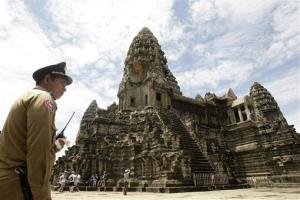
Beyond Angkor: How lasers revealed a lost city

Ancient 'Lost City' Brought to Life With Lasers

In this photo taken on June 28, 2012, a police officer stands guard at Cambodia's famed Angkor Wat temple complex in Siem Reap province.
 (AP Photo/Heng Sinith)

By Ben Lawrie

1)  How do we know what happened in the past?  Can we trust personal accounts? How reliable is a diary for historical evidence?  Should historians or scientists receive credit for this "discovery"?  Should someone else?     

2)  Why might a Cambodian and a French person have different perspectives on the excavation of Angkor?  How might an archaeologist from 100 years ago see this differently from a modern-day archaeologist?     

3)  What is your town's "Angkor Wat"?  In what ways is Angkor Wat like Rome?  Athens?  Mexico City?  The Moon?  What was happening in different parts of the world at the height of Angkor Wat?

4)  What would happen if we allowed people to build without restriction on ancient sites?  What if construction was restricted on sites older than 100 years?  1000 years?  10 years?  

5)  What is the significance of this story?  Who is affected by the new methods used to map Angor?  Is it ethical to excavate ancient sites?    
Extension Activities:

1)  Students can research similar "lost cities" to compare and contrast their development, rise, and fall.  
2)  Students can read a chapter from Jared Diamond's Collapse and report back to the large group on how resource depletion can lead to abandonment of cities.
3)  Students can predict how major cities of the world will grow or decline in prominence.
4)  Students can journal as the city through a personified life time (i.e., When was Ankgor a teenager, how did it feel, what was happening?, as it grew older? etc.)